Every year, thousands of visitors enter Pench National Park with one shared hope to spot a Royal Bengal Tiger in the wild. That wish is natural, even beautiful. But the way tourists behave inside the forest has a direct and measurable effect on the very tigers they come to see. Understanding this impact is no longer optional. It is the responsibility of every person who enters Pench National Park.
How Tourist Behavior Affects Tiger Movement
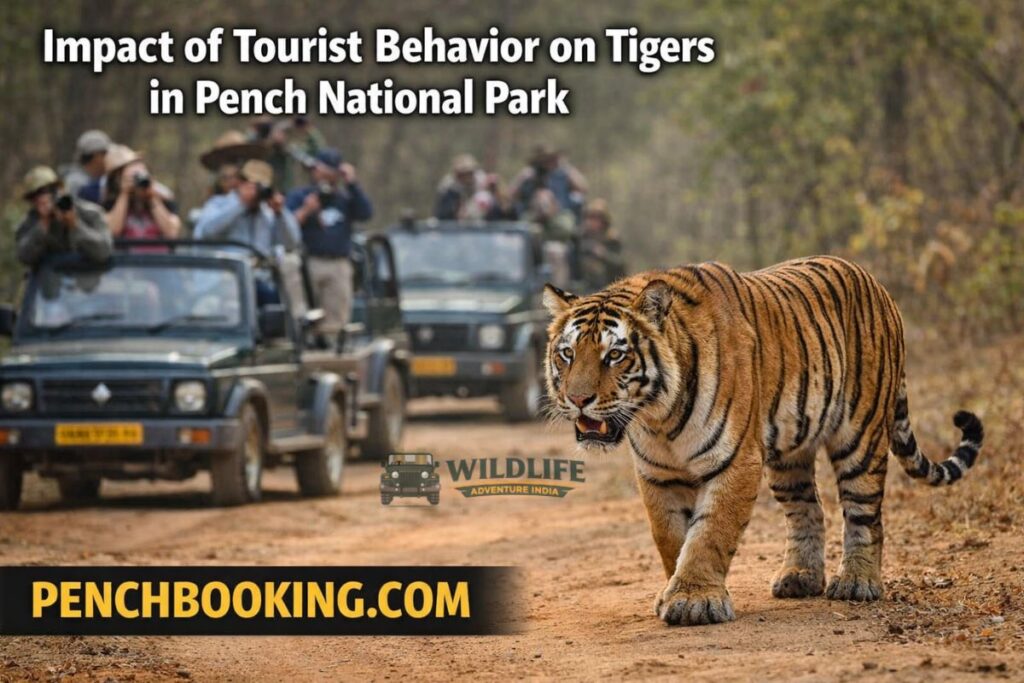
Tigers are highly territorial and deeply sensitive to disturbance. When safari vehicles crowd a single sighting spot which happens frequently at popular zones inside Pench tigers often change their movement to avoid the area. A tiger that would normally pass through a waterhole or a forest trail during daylight hours may shift its timing to avoid vehicle presence entirely. Over time, repeated disturbance can push tigers away from tourism zones and deeper into the forest, reducing natural sighting patterns and disrupting their established territory.
This behavioral shift is not just an inconvenience for tourists. It affects the tiger’s hunting efficiency, daily caloric needs, and even territorial signaling to other tigers
Noise: The Most Overlooked Threat
Noise inside the safari zone is one of the most direct and damaging forms of tourist disturbance. Honking, raised voices, loud camera sounds, and music from vehicles create an unnatural sonic environment that tigers associate with danger. When a tiger hears consistent, unpredictable noise from human sources, it triggers a stress response, the same biological mechanism that prepares the animal to flee a predator.
Pench National Park strictly prohibits the use of horns, transistors, and any noise-making devices inside the forest. Yet violations by uninformed or impatient tourists continue to occur. The cumulative effect of noise disturbance across hundreds of safari sessions each season is significant, especially for tigresses with cubs who are more alert and reactive to perceived threats.
Speeding and Off-Road Driving
The speed limit inside Pench is capped at 20 kmph. This rule exists not just to prevent accidents but to reduce the stress caused by fast-moving vehicles on all wildlife, including tigers. When a vehicle approaches a tiger at speed, the animal can perceive it as a charging threat. The tiger may respond by retreating into dense cover, becoming aggressive, or abandoning a kill site all outcomes that are harmful to the animal’s welfare.
Some safari drivers, under pressure from tourists demanding closer views, push beyond permitted zones or accelerate to reach a sighting faster than other vehicles. This competitive behavior among vehicles is a serious concern inside Pench and directly translates into stress on individual tigers repeatedly exposed to such situations.
Feeding and Artificial Attraction
Throwing food to attract wildlife is prohibited inside Pench National Park, yet it still occurs. When tourists feed animals, even smaller ones like deer or langurs, it creates artificial congregation points that can disrupt the natural prey distribution that tigers depend on. More critically, if tigers ever associate human presence with food, their natural wariness toward humans begins to erode. This is a dangerous behavioral shift that puts both future tourists and the tiger itself at risk.
Any attempt to attract a tiger through sound, gesture, food, or bait is not only illegal but fundamentally alters the wild nature of the animal.
Flash Photography and Its Effect on Tigers
Flash photography during close-range sightings causes sudden, intense light exposure that can temporarily disorient tigers, particularly young cubs whose vision and reflexes are still developing. A disoriented cub may separate from its mother in panic, increasing its vulnerability. Even adult tigers exposed to repeated flash photography during close encounters may develop avoidance behavior toward safari vehicles, making future sightings rarer for everyone.
Wildlife photography at Pench should always use natural light or silent, high-ISO settings that do not require a flash.
The “Celebrity Tiger” Problem
Inside Pench’s tourism zones, certain tigers, often the most visible and habituated ones, become unofficial celebrities. Guides and drivers share real-time sighting updates, leading to a rush of vehicles converging on one animal. This tiger is then surrounded, watched, and photographed continuously throughout the safari session.
While the tiger may appear calm on the surface, being under constant observation affects its behavior over time. It may delay mating activity, interrupt a hunt, or abandon a territory if human presence becomes constant. Some of the most documented tigers in Indian reserves have shown measurable behavioral changes due to sustained tourist attention. The tiger’s survival instincts are built for a wild, undisturbed forest not a stage.
Rules Every Tourist Must Follow
These rules are not suggestions. They are the minimum standard of behavior inside Pench National Park:
- Stay inside the vehicle at all times during the safari
- Maintain complete silence when wildlife is nearby
- Do not use flash photography under any circumstances
- Do not honk, play music, or use any noise-making device
- Do not throw food or attempt to attract wildlife
- Respect the 20 kmph speed limit strictly
- Do not pressure guides or drivers to enter restricted zones
- Follow every instruction from your assigned naturalist or guide
Each of these rules exists because tourist behavior at close range has been directly linked to tiger stress, behavioral change, and habitat avoidance.
Why This Matters for Tiger Conservation
The tigers of Pench are not used to human presence by nature; they are habituated to it through repeated exposure in tourism zones. That habituation is fragile. It relies on tourists consistently behaving in ways that do not trigger fear or stress responses. The moment tourist behavior becomes unpredictable through noise, speed, flash, or crowding that habituation breaks down and the tiger’s natural stress responses take over.
Every irresponsible act inside the forest, no matter how small it seems to the individual tourist, adds to a cumulative burden on the tiger. And every responsible act staying quiet, keeping distance, following the rules reduces that burden and protects the animal’s welfare for every visitor who comes after.
Want to see how responsible tourism and conservation come together to protect these majestic cats?
👉 Explore The Journey of Pench: A Model of Big Cat Conservation and discover how this reserve became a success story.
Conclusion
A tiger sighting in Pench is not just a moment of thrill; it is a privilege that comes with responsibility. The forest is not a safari park designed for human convenience, but a living ecosystem where every sound, movement, and action has consequences. The behavior of each tourist shapes the experience not only for themselves but for the wildlife and every visitor who follows.
If Pench is to remain one of India’s finest tiger habitats, conservation cannot rely only on forest authorities; it must be supported by informed and responsible tourism. By respecting the rules, maintaining discipline, and understanding the impact of our presence, we ensure that tigers continue to move freely, hunt naturally, and live without stress in their own territory.
In the end, the true success of a safari is not how close you get to a tiger, but how little your presence changes its world.
FAQs
Yes. Research on tiger reserves across India shows that tigers in high-tourism zones alter their movement, reduce daytime activity, and shift territory boundaries in response to sustained vehicle pressure.
Flash photography causes sudden disorientation and stress, especially in cubs. It is strongly discouraged and should be avoided entirely during close sightings.
Violations can result in immediate removal from the park, cancellation of safari permits, and fines. Repeat offenses by vehicle operators can lead to license suspension.
Persistent feeding, teasing, or habituation through irresponsible behavior can erode a tiger’s natural wariness toward humans, which increases the risk of conflict for both the animal and future visitors.
Maintain distance, keep your voice low, turn off the vehicle engine when a tiger is nearby, never demand closer access, and follow your guide without question. The best sightings always come to those who are patient and still.
Absolutely. When tourists collectively respect park rules, tigers maintain natural behavior patterns, territories stay stable, and the overall health of the ecosystem is preserved which is the foundation of all tiger conservation.