
Penchbooking.com, operated by Wildlife Adventure India, is a trusted private travel partner for Pench National Park safari bookings, accommodation, and curated wildlife tours. Safari permits are issued exclusively through official government portals, and we assist travelers with planning and booking services across all major zones.
About Pench National Park
Pench National Park is one of central India's most captivating wildlife destinations. For anyone who has read The Jungle Book, visiting Pench feels emotional — this is the real forest. The same teak-covered hills, the same river, the same ancient trees and grasslands where tigers still roam at dawn and wolves howl at night. The world Rudyard Kipling imagined in 1894 isn't fiction — it's real, and it's still very much alive here today.
Where Exactly Is Pench National Park Located
Pench National Park sits on the southern border of Madhya Pradesh, across Seoni and Chhindwara districts, extending into Nagpur district of Maharashtra. It lies on the lower slopes of the Satpura Range, at around 21°40' N, 79°18' E.The park is roughly 90 to 100 km from Nagpur, 168 km from Jabalpur, 25 km from Seoni town, and 48 km from Chhindwara — making it easily reachable from major cities in both states.
Geography and Terrain
Pench's terrain is varied — small hills, rolling valleys, rocky outcrops, open grasslands and dense forest slopes, with elevation ranging from 425 to 620 metres. The highest point, Kala Pahad (Black Mountain), rises to about 650 metres inside the Turia core zone.On a clear morning, its summit offers views of teak forest stretching across the Satpura hills. The soil varies too, with fertile sandy loam in valleys and red stone or saline soil in higher areas.
What Is the Total Area of Pench National Park
Pench Tiger Reserve covers 1,179.63 sq km on the Madhya Pradesh side, with a 411.33 sq km core area kind of made up of the national park (292.857 sq km) and Pench Mowgli Sanctuary (118.473 sq km) and then there's also a 768.30 sq km buffer zone.On the Maharashtra side, the core stretch is 257.3 sq km while the buffer comes to 483.96 sq km. Put all of it together, the whole reserve is spread across both states, over 1,920 sq km.
The Pench River — The Soul of the Park
The park is named after the Pench River, which originates in the Satpura range near Junnardeo village at 1,048 metres elevation. It flows 74 km through the reserve, splitting it into two halves — Gumtara Range in the west and Karmajhiri Range in the east.The river later joins the Kanhan, then the Wainganga and Godavari systems. In summer, it shrinks into small pools called dohs, becoming vital water sources and top tiger-spotting spots.
The Totladoh Reservoir
Where the Pench River enters Maharashtra, the Totladoh Dam (Pench Dam) created the Totladoh Reservoir — the largest water body in the reserve, covering about 72 sq km (54 in MP, 18 in Maharashtra).It was Maharashtra's first major interstate water project and supplies over 70% of Nagpur's drinking water. Inside the reserve, it's a year-round water source supporting rich aquatic life, water birds, and the park's only boat safari.
Climate and Weather in Pench National Park
Pench has three distinct seasons. Summer (March–June) sees temperatures from 28°C up to a scorching 45–49.5°C in May. Winter (October–February) is pleasant, ranging from 10°C to 22°C, though nights can drop to minus 2°C in December–January.Monsoon (July–September) brings 1,100–1,400 mm of rainfall, turning the dry golden forest lush and green almost overnight. Annual average rainfall is about 1,133 mm.
The Forest Types of Pench National Park
Pench is mostly a tropical dry deciduous forest, but it sort of has three distinct types in it. One is moist deciduous forest and it tends to grow in sheltered valleys. Then there is teak-dominated dry deciduous forest, which covers most of the whole landscape.And the dry mixed deciduous forest kind of fills the drier and transitional patches. With these three forest types combined, you get a rich mosaic of habitats, it supports higher biodiversity too, and Pench ends up with one of the highest densities of herbivores and predators among the tiger reserves of central India.
The Jungle Book Connection
Pench's most famous identity is its link to The Jungle Book. Kipling wrote it in 1894, inspired by Seoni's forests, the 1831 wolf child story, and writings by Strendale, Forsyth and Sleeman.Mowgli, Bagheera, Baloo, Shere Khan and Akela were all inspired by Pench's real animals and landscapes. Even the Wainganga River and Khapa village have real-world counterparts here — making a safari feel like stepping into the story itself.
Project Tiger and Conservation Success
Pench has been one of Project Tiger's biggest success stories. When declared a reserve in 1992, its tiger population was just around 30. Thanks to decades of anti-poaching efforts, habitat restoration and scientific management, numbers have grown to 45–75 tigers today. Collarwali, who gave birth to 29 cubs, symbolizes this success. Pench also links to Kanha Tiger Reserve through the Rukhad corridor, helping tigers move freely and maintain healthy genetic diversity.
Wildlife Significance
Pench has an ungulate density of about 90.3 animals per sq km and a biomass density of 6,013.25 kg per sq km — India's second-highest after Nagarhole. This rich prey base and strong protection make it one of India's best parks for tiger sightings. Pench also protects endangered species like four vulture species, the rare four-horned antelope, the Indian wolf, and the elusive black panther spotted in the Karmajhiri zone.
Quick Facts About Pench National Park
Flora and Fauna of Pench National Park
Pench National Park is home to incredible biodiversity, from towering teak trees to open grasslands and mixed deciduous forests. When you explore the complete Flora and Fauna of Pench you'll discover tigers, leopards, gaur, sloth bears, wild dogs and over 300 bird species — a rich ecosystem that makes every safari here truly unforgettable.
Flora of Pench National Park
Pench National Park is covered in a tropical dry deciduous forest and, where teak happens to be the most dominant tree species in the whole reserve. The forest floor stays richly layered with things like mahua, saja, jamun, bamboo, amaltas, haldu, salai and even the noticeable white kulu tree, locally called the ghost tree for its pale silver bark, that really pops against the green canopy. On the open grassland bits, seasonal grasses and shrubs spread out and that, in turn provides essential grazing for chital, sambar and Indian gaur all year long. The buffer zones also hold medicinal plants such as ashwagandha, sarpagandha and shatavari, which local Gond and Baiga tribal communities have used for generations as natural remedies, you know. More than 1000 species of plants have been recorded within Pench Tiger Reserve, so it is considered one of the richest dry deciduous forest ecosystems in all of central India.
Fauna of Pench National Park
Pench is home to the iconic Royal Bengal tiger, and right now there are 80+ tigers living inside the reserve which means every Pench jungle safari feels genuinely thrilling, not just "pretty". You can also spot the Indian leopard plus its rare melanistic look, basically the black panther, together with Indian wild dog, sloth bear, Indian gaur, Indian wolf, striped hyena and a plentiful bunch of deer species like sambar chital barking deer nilgai and the rare four horned chousingha.On top of that, over 300 types of resident and migratory birds have been seen here, such as the Indian pitta, osprey, grey headed fishing eagle, Malabar pied hornbill and six kinds of endangered vultures. If you walk near the Pench River or the Totladoh Reservoir you may also meet mugger crocodiles, Indian rock python, monitor lizards and freshwater turtles, plus more than 105 species of butterflies and 50 species of freshwater fish, so overall it's a pretty intense ecosystem, in a good way.
Collarwali — The Supermom of Pench
Collarwali is the most famous tiger in Pench's history and one of India's most celebrated wild tigers. Named after the radio collar researchers used to track her, she lived in the Turia core zone and gave birth to 29 cubs across multiple litters — the most productive tigress ever recorded in an Indian tiger reserve.The BBC documentary Tiger Spy in the Jungle made her an international celebrity. She passed away in January 2022 at age 17, a remarkably old age for a wild tiger, and was mourned by wildlife lovers nationwide. Her legacy lives on through the dozens of tigers she brought into Pench's forests.
Discover Collarwali's LegacyBest Time to Visit Pench National Park
October to February
5°C to 22°C · Peak Safari SeasonWinter is the most comfortable and best time to visit Pench, with cool, clear days but cold early mornings — pack warm layers for gypsy safaris. All core zones in MP and Maharashtra stay open. Migratory birds arrive in large numbers near Totladoh Reservoir and the Pench River, making this the best season for birdwatching alongside strong overall wildlife activity.
Comfortable safaris · birdwatching · family tripsMarch to June
28°C to 46°C · Tiger SeasonSummer offers the best tiger sightings in Pench. As the forest dries out, waterholes like Baginnalla, Junewani and Ghursalghat become vital water sources, drawing tigers, leopards, gaur and deer regularly. April, May and early June are peak months for sightings across all zones. Midday heat is intense, so early morning safaris are recommended for the most rewarding experience.
Tiger & leopard sightings · photographyJuly to September
22°C to 33°C · Park Partly ClosedDuring monsoon, core zones in both MP and Maharashtra close, letting the forest recover and wildlife breed undisturbed. However, Maharashtra's Surewani buffer zone stays open for gypsy safaris. Within days, the dry teak forest turns lush green, and occasional tiger sightings still occur in buffer zones — making this a quieter, more budget-friendly time to visit.
Budget travel · monsoon photographyThings to Do in Pench National Park
Pench Tiger Reserve is far more than just a tiger safari. The things to do in Pench go well beyond wildlife drives — from after-dark night safaris and quiet forest walks to boat rides on the Totladoh Reservoir and tribal village visits, there is something genuinely unforgettable waiting for every kind of traveller who arrives here
Birdwatching in Pench National Park
With over 300 recorded bird species, Pench is one of the finest birdwatching destinations in all of central India. Resident species like the Indian pitta, osprey, Malabar pied hornbill and six species of endangered vultures are present year round, while thousands of migratory waterfowl including bar-headed geese, pintail duck and brahminy duck arrive at the Totladoh Reservoir every winter.
Runijhuni Nature Walking Trail
Starting from the Karmajhiri Gate, the Runijhuni Trail is one of the only on-foot wildlife experiences available inside Pench Tiger Reserve. A trained naturalist walks beside you through real teak and bamboo forest, pointing out fresh tiger pug marks, identifying birds by their calls, explaining the medicinal plants used by local tribal communities and helping you experience Pench at a ground level that a moving gypsy simply cannot reach.
Cycling Safari in Rukhad Zone
The cycling safari through the Rukhad buffer zone is a rare experience that very few tiger reserves in India offer to visitors. Pedalling quietly through the forest at dawn, you notice things that a gypsy always rushes past, the fresh tracks of a leopard pressed into the mud, a spider web stretched between bamboo stalks and the morning call of a magpie robin floating down from the canopy high above.
Visit Pachdhar Pottery Village
Just 15 km from Turia Gate there is this small, and honestly very charming place, Pachdhar. Here about 100 Kumhaar potter families have been working traditional clay pots diyas kulhars and even figurines, using the very same wheel methods for generations. You can stand there and see a potter shape a lump of clay into something beautiful in under a minute, and that sort of lowkey memorable moment, it follows you around long after the tiger sightings start fading away.
Stargazing near the Forest
Pench Tiger Reserve is pretty far from any city lights. So the night sky over the forest, it feels super clear and packed with stars, like you don't really get elsewhere in India. On a cloudless evening, if you're outside your jungle resort, the Milky Way is stretched out and fully visible from one end of the sky to the other. That's why stargazing near Pench becomes one of those unexpectedly magical parts of a wildlife break.
Explore Kohka Lake
Kohka Lake is a hidden and peaceful natural gem located just 10 km from Turia Gate through winding forest roads and quiet villages that feel completely untouched by tourism. Early mornings here bring a beautiful mist sitting low over the calm water as the first birds begin calling from the trees around the shore, and late afternoons deliver some of the most beautiful sunsets you will find anywhere in Madhya Pradesh.
Village Haat and Tribal Culture Tour
The weekly village haats held near Pench National Park are among the most colourful and authentic experiences you can add to your Pench Tiger Reserve trip. Local Gond and Baiga tribal communities gather here to sell forest produce, handmade goods and traditional food, giving every visitor a real and unhurried look into the living culture of central India that no resort experience can ever replicate.
Wildlife Photography Safari in Pench
Pench is one of the finest wildlife photography destinations in central India, with its open teak forest, reliable waterhole sightings and consistently high wildlife density giving photographers the kind of varied and close-up opportunities that are genuinely hard to find at most other tiger reserves. Golden hour tiger shots near Baginnalla waterhole and black panther sightings in the Karmajhiri zone make Pench a serious destination for wildlife photographers at every level.
Visit Nearby Waterfalls from Pench
Pench sits at the centre of one of the most naturally rich regions in all of Madhya Pradesh and Maharashtra. Tamia Waterfall in Chhindwara is just 60 km away, while Bee Falls and Silver Falls in Pachmarhi and the dramatic Dhuandhar Falls at Bhedaghat are all very doable day trips that turn your Pench jungle safari holiday into a complete and deeply rewarding central India nature adventure.
History of Pench National Park
From ancient forest lands to one of India's most celebrated tiger reserves, the history of Pench National Park is far older and far richer than most visitors realise. It does not begin in 1983 when it was officially declared a national park, and it does not begin in 1977 when it first received protection as a wildlife sanctuary. The real story of this forest stretches back centuries, deep into the teak-draped hills of the Seoni and Chhindwara districts of central India, where this landscape was already one of the most naturally abundant and biologically significant wild territories on the entire Indian subcontinent — long before any boundary was drawn around it.
The earliest written trace of Pench's forests goes back to the 16th century, when Emperor Akbar was still in reign. His court minister Abu'l-Fazl noted the region's natural abundance, kind of like the flora and fauna, in the Ain-i-Akbari, which was one of the Mughal Empire's most key administrative records. And that pretty much shows that, even back in the 1500s, Pench was seen as a place with extraordinary natural richness, like an unmistakable kind of abundance. The Mughals also treated the forest as a royal hunting ground, and they really valued it for its tigers, deer, and the plenty of wildlife.
Before the Mughals, this region was part of Gondwana, ruled by the Gond tribal kings. The Gond communities living around Seoni and Chhindwara shared a deep, respectful bond with the land, seeing the forest as a living world rather than a resource to exploit. Their reverence helped preserve its biodiversity for centuries. The Gond, Baiga and Kumhaar communities near the park today are direct descendants of these original forest guardians.
In 1831, a child believed to be raised by wolves was found near Sant Bawadi village in Seoni. British officer Lt. Moor documented the discovery, and attempts to integrate the child into human society failed. Sir William Sleeman later recorded this true story in his writings. This account eventually reached Rudyard Kipling, becoming the real-life seed that inspired the creation of The Jungle Book.
British naturalists such as R.A. Strendale, J. Forsyth and Dunbar Brander, documented Seoni wildlife and the whole landscape in vivid detail. Later Kipling, stirred by those accounts and the wolf child story, wrote The Jungle Book in 1894, and in it he made Mowgli, Bagheera, Baloo Shere Khan too. Now Kipling probably never set foot in Seoni directly, but even so his descriptions seem to fit the region, quite closely. Today, Pench is proudly known worldwide as "Mowgli Land."
By about the mid-20th century, Pench forests were getting hit by more and more threats, deforestation, farming expansion, and also illegal hunting sort of, so legal protection became urgent. In September 1977 the Madhya Pradesh Government declared Pench a Wildlife Sanctuary, with an area of 449.39 sq km. That decision was the first real legal protection for the forest, it limited harmful human activities and protected tigers, leopards, gaur, and countless other kinds of life, really sort of like the start of a long conservation journey.
In 1983, six years after the sanctuary declaration, the core strip of Pench was up-graded to National Park status, covering 292.857 sq km spread over Seoni and Chhindwara districts. About 118.473 sq km was still sanctuary land, while 38.062 sq km got left out. This big turning point ushered in tighter protection, dedicated government support, improved wildlife monitoring and a stronger pull of interest from conservationists, and even tourists, from across the country.
In November 1992, Pench was brought under Project Tiger, India's flagship tiger conservation programme, becoming the country's 19th official Tiger Reserve. This status brought dedicated anti-poaching resources, professional wildlife management and increased national funding. The reserve unified the national park, the Mowgli Pench Wildlife Sanctuary and a buffer zone under one management system — forming the comprehensive Pench Tiger Reserve that exists today.
In 1995, the management of the Pench sanctuary area was more or less formally moved over to the Tiger Reserve authorities, so the whole landscape ended up under a single coordinated system, for the first time. That joining together helped with better patrolling, sharper wildlife observation, and also stronger anti poaching measures. When you managed the national park alongside the sanctuary it turned out to be far more efficient than keeping them as separate units, with separate teams and all that.
In 1998, the Pench Sanctuary received its final legal recognition through formal notification by the Madhya Pradesh Forest Department. This step gave the sanctuary the same strong government protection already enjoyed by the national park, closing legal loopholes that had previously made enforcement difficult in the reserve's outer areas — completing an important part of its long administrative journey.
In 2002, the national park got a new name, Indira Priyadarshini Pench National Park, honoring the former PM Indira Gandhi and her role in strengthening India's wildlife laws. At the same time, the sanctuary was also called Pench Mowgli Sanctuary, which is a kind of nod to its literary link to The Jungle Book, I guess. Together these changes paid tribute to conservation history as well as cultural heritage, and today both names are still used with real pride.
In 2005, the Madhya Pradesh Government issued the final official notification for Pench National Park, completing over two decades of legal work. This gave the park fully secure, permanently protected status under Indian law. With this notification, Pench stood firmly established in every legal and administrative sense, with clearly defined boundaries and the strongest possible government protection.
In 2007, both the National Park and Sanctuary areas were declared the Core Zone of Pench Tiger Reserve. This placed the forest's most critical, wildlife-rich areas under the highest level of protection under Indian law. Within this zone, human activities are strictly controlled, with top priority given to the undisturbed movement, breeding and survival of wildlife — especially tigers.
In 2010, the Buffer Zone of Pench Tiger Reserve was officially notified, completing the full territorial structure of the reserve. The buffer zone of 768.30 sq km surrounds the core zone and serves as a transition area between the fully protected forest and the human-inhabited landscape beyond, allowing for managed eco-tourism, sustainable forest use and community-based conservation activities that give local people a meaningful role in protecting the forest.
In 2022, the Karmajhiri Wildlife Sanctuary covering 14.140 sq km was formally added to the Pench Tiger Reserve landscape, expanding the protected corridor and giving wildlife more connected forest land to move through safely. This addition demonstrated that the commitment to protecting and growing the Pench ecosystem remains as active and determined today as it was when the journey first began in 1977.
The BBC Documentary — Tiger Spy in the Jungle
One of Pench's biggest moments, kinda came when the BBC picked it as the shooting spot for their wildlife documentary Tiger Spy in the Jungle, narrated by David Attenborough. The whole documentary tracked four tigers living inside Pench, and they used hidden cameras plus little "spy robots" disguised as jungle creatures to catch rare, never-seen-before footage of tiger conduct. When it was broadcast globally, it shoved international attention toward Pench in a way that a simple tourism push never really could. And yeah, the legendary tigress Collarwali, well known for giving birth to 29 cubs, ended up being one of the documentary's main highlights, which added even more to Pench's fame worldwide.
The Collarwali Legacy
No history of Pench is complete without Collarwali, the tigress who became the living symbol of its conservation success. Named after the radio collar she wore when first tracked in the early 2000s, she lived in the Turia core zone and gave birth to 29 cubs across multiple litters — the most prolific wild tigress ever recorded in India. Her descendants now roam across Pench and beyond. She passed away in January 2022 at age 17, mourned as a national loss, and a memorial statue now honours her inside the reserve
Nearby Places From Pench National Park
Planning a visit to Pench and want to know what else is around? From ancient temples to quiet hill escapes and wildlife spots, there is a lot waiting near the park. Check out our full guide to the best places to visit near Pench National Park and plan your trip better.
Kanha National Park
Often called the tiger capital of central India, Kanha National Park is famous for its healthy tiger population, sprawling meadows and status as another inspiration behind The Jungle Book. Its close distance from Pench makes it easy to combine both parks into one unforgettable central India wildlife itinerary.
Tadoba Tiger Reserve
Tadoba Tiger Reserve is widely regarded as Maharashtra's finest tiger park, known for having some of the highest tiger sighting rates in all of India. Its dense forests and open grasslands make it a top choice for wildlife photographers and serious tiger enthusiasts visiting the region around Pench.
Nagpur
Nagpur, the nearest major city and main gateway to Pench, is well connected by air, rail and road. Beyond being a convenient travel hub, Nagpur is culturally significant for Deekshabhoomi, a major Buddhist monument, and is also famously known as the "Orange City" of India.
Tamia Hill Station
Tamia is the closest offbeat hill station to Pench, offering cool weather, scenic viewpoints and untouched natural beauty. Nearby attractions include the Sahastradhara waterfall and the mysterious Patalkot valley, making Tamia a peaceful escape for travellers looking to combine wildlife safaris with relaxing hill views.
Seoni
Seoni is the nearest town to Pench and holds a special place in history as the heart of "Mowgli country," the real-life inspiration behind The Jungle Book. The town also features an ancient Shiva temple and vibrant local markets, giving visitors a glimpse of authentic small-town Madhya Pradesh life.
Chhindwara
Chhindwara serves as the gateway to the mysterious Patalkot valley and is home to the scenic Ghogra Falls. Deeply rooted in tribal heritage, Chhindwara offers visitors a chance to explore local culture, traditions and natural beauty beyond the boundaries of Pench Tiger Reserve.
Bhedaghat
Bhedaghat is famous for the stunning Dhuandhar Falls and the breathtaking marble rock gorge carved by the Narmada River. Boat rides through the towering marble cliffs offer one of central India's most unique and picturesque natural experiences, making it a popular day trip destination from Pench.
Ramtek Temple
Ramtek Temple is an ancient and sacred hilltop shrine with deep historical significance. It is believed to be the very place where the legendary poet Kalidas wrote his famous work Meghdootam. The temple's spiritual atmosphere and hilltop views make it a meaningful stop for culturally curious travellers.
Khindsi Lake
Located near Ramtek Temple, Khindsi Lake is a scenic and peaceful spot surrounded by hills, perfect for boating and relaxed picnics. Its calm waters and natural surroundings make it a popular short getaway for families and travellers looking to unwind after wildlife safaris in Pench.
Nagzira Wildlife Sanctuary
Nagzira Wildlife Sanctuary is a peaceful, uncrowded reserve in Maharashtra, known for its rich biodiversity and the beautiful Nagzira Lake. Offering a quieter alternative to the busier tiger reserves nearby, Nagzira is ideal for visitors seeking a calm, nature-immersive wildlife experience away from the crowds.
Importance of Pench National Park in Indian Wildlife Tourism
Pench National Park holds a special place in India's wildlife conservation and tourism story — one that goes far beyond being just another tiger reserve. For most people, the connection to Pench begins in childhood, through The Jungle Book. The very teak forests that inspired Kipling to create Mowgli, Bagheera and Shere Khan are the same forests visitors walk through on a gypsy safari today, giving Pench a cultural significance few wildlife destinations can claim.
From a conservation standpoint, Pench has been one of India's most successful tiger projects. Its once-dangerously-low tiger population has grown to 80+ individuals today. Collarwali, the tigress who gave birth to 29 cubs, became a symbol of this success and was featured in the BBC's Tiger Spy in the Jungle, bringing global attention to Pench.
Visitors can explore the park through different Pench safari zones, each offering its own unique forest terrain, wildlife habitat and safari experience.
The park also kind of sits right in the middle of a vital wildlife corridor, linking up Pench and Kanha Tiger Reserves through the Rukhad buffer zone. So this helps tigers, leopards, gaur, and wild dogs to move more or less freely, keeping up solid genetic diversity and all that. For Indian wildlife tourism, Pench feels like that perfect middle ground — close enough to Nagpur for a weekend getaway, but still wild enough so it feels really secluded once you step in through the gate.
How to Reach Pench National Park
By Air — Nearest Airport to Pench National Park
The nearest airport to Pench National Park seems to be Dr. Babasaheb Ambedkar International Airport, in Nagpur, Maharashtra. It's roughly 120 km from Turia Gate and around 170 km from Karmajhiri Gate. Nagpur actually has pretty strong domestic connections to Delhi, Mumbai, Hyderabad, Bengaluru, Chennai, Kolkata, Pune and Ahmedabad, along with overseas services to Dubai....
After you land, taxis or resort transfer arrangements get you to Pench in about 3-4 hours, mainly via NH44. Jabalpur Airport is the second option, around 200–215 km away, with limited flights mainly from Delhi. It can be more convenient for Delhi travellers heading to Pench from the Jabalpur side.
By Train — Nearest Railway Station to Pench National Park
Seoni Railway Station is the closest to Pench, just 25–30 km from Turia Gate, but it has limited train frequency and few direct connections to major cities. Nagpur Railway Station is the best-connected option, linked to Delhi, Mumbai, Kolkata, Chennai, Hyderabad, Pune, Bhopal, Jabalpur and Varanasi....
From here, Pench is about 90–100 km, roughly 2 to 3 hours by road, with taxis easily available outside the station. Jabalpur Railway Station, located around 185–205 km away, is a convenient transit hub for travellers arriving from Delhi, Agra, Varanasi, or Bhopal.
By Road — Driving to Pench National Park
Pench sits directly on NH44, the Nagpur-Jabalpur highway — the best way to reach Pench by road, making the drive smooth and scenic with good roads and clear signage.
From Nagpur: 90 to 100 km, about 2–3 hours — the most popular route.
From Jabalpur: 168 km, about 3–3.5 hours, through scenic forest landscapes....
From Bhopal: 390 to 420 km, about 5–6 hours, via Chhindwara. From Delhi: 1,000 km, about 15–16 hours — most visitors prefer flying to Nagpur and driving the last stretch. From Mumbai: 867 km, about 12–13 hours, a feasible overnight road trip.
Local Transport from Pench Gates
Once you reach the Pench area, most jungle resorts and hotels arrange complimentary airport and railway station pickup services from Nagpur. Local taxis and auto-rickshaws are available at Khawasa village near Turia Gate. The Pench Tiger Reserve also has tie-ups with local vehicle operators for transfers between the different gates, which is useful for visitors who want to do safaris in both the Madhya Pradesh and Maharashtra zones during the same trip.
Entry Gates of Pench and How to Reach Each
Turia Gate — Madhya Pradesh Side
The most popular and most accessible entry gate, located 90 to 100 km from Nagpur on NH44. Most jungle resorts and hotels near Pench are situated close to this gate. Ideal for visitors from Nagpur, Maharashtra and those flying into Nagpur airport.
Karmajhiri Gate — Madhya Pradesh Side
Located approximately 140 km from Nagpur via the Suktara route. Slightly less crowded than Turia and best for visitors who prefer a quieter safari experience with access to the black panther zone and Runijhuni nature walk.
Sillari Gate — Maharashtra Side
Located approximately 29 km from Khawasa on the Maharashtra side of the reserve, around 70 km from Nagpur. The most popular entry gate for visitors from Maharashtra and from Nagpur who want to explore the Maharashtra zones of Pench.
Khursapar Gate — Maharashtra Side
Located around 18 km from Turia Gate and easily accessible from both MP and Maharashtra. Good for visitors who want to combine safaris on both sides of Pench in the same trip.
Your Trusted Partner for Pench Safari Adventures
We specialize in providing a seamless and hassle-free Pench National Park online safari booking experience, helping travelers secure jeep safari permits in Pench Tiger Reserve through official government portals. Safari permits are issued exclusively by authorized forest department websites, and we assist visitors with complete planning support, including Pench tiger safari booking in Madhya Pradesh and Maharashtra zones, best zone selection for tiger sighting in Pench, and real-time availability guidance.
Our company provides specialized Pench wildlife tour packages together with two types of accommodations which include luxury resorts and budget resorts that are situated near Pench National Park. Our services include family-friendly jungle safari tours and corporate wildlife retreats and last-minute safari booking assistance for Pench National Park. Our team provides well-planned experiences which create lasting memories for customers who want to visit Pench National Park to see tigers and stay in Turia gate area hotels and book Kolara gate safaris and experience a complete wildlife weekend from Nagpur to Pench National Park.
Penchbooking.com enables wildlife enthusiasts and photographers and nature lovers who wish to experience an unforgettable tiger safari in Pench Tiger Reserve India to book their jungle safari permits online through expert local knowledge and transparent guidance and dedicated customer support which makes the process simple and reliable and convenient.
Our Services
Plan your perfect Pench adventure with our comprehensive services.
Online Safari Booking
Online Safari Booking for Pench National Park with secure tiger safari permit reservation and instant jeep safari confirmation online.
Book NowTour Packages
Affordable Pench National Park tour packages with tiger safari booking, luxury resorts stay, and customized wildlife holiday packages.
Explore PackagesHotel Booking
Hotel booking near Pench National Park with luxury jungle resorts, budget stays, and safari-friendly accommodation at best prices.
Find HotelsFrequently Asked Questions
What is Pench National Park?
Pench National Park is one of central India's most famous wildlife destinations, located across Seoni and Chhindwara districts of Madhya Pradesh and Nagpur district of Maharashtra. It is also known as "Mowgli Land" due to its connection with Rudyard Kipling's The Jungle Book.
Where exactly is Pench National Park located?
Pench sits on the southern border of Madhya Pradesh, extending into Maharashtra. It is approximately 90–100 km from Nagpur, 168 km from Jabalpur, and 25 km from Seoni town.
What is the total area of Pench Tiger Reserve?
The total area of Pench Tiger Reserve across both Madhya Pradesh and Maharashtra is over 1,920 sq km. The MP side alone covers 1,179.63 sq km, with a core zone of 411.33 sq km and a buffer zone of 768.30 sq km.
How many tigers are there in Pench National Park?
Pench Tiger Reserve is currently home to 80+ Royal Bengal Tigers, making it one of the best parks in India for tiger sightings.
What is the best time to visit Pench National Park?
October to February is best for comfortable safaris and birdwatching. March to June is the top season for tiger sightings, as animals gather near waterholes. Monsoon months (July–September) see the core zones closed.
Is Pench National Park open during monsoon?
No. The core zones in both Madhya Pradesh and Maharashtra remain closed during the monsoon (July to mid-October). However, Maharashtra's Surewani buffer zone stays open for safaris during this period.
What wildlife can I see in Pench?
You can spot Royal Bengal Tigers, Leopards (including the rare Black Panther), Sloth Bears, Indian Gaur, Indian Wild Dog, Striped Hyena, Sambar, Chital, Barking Deer, Nilgai, Mugger Crocodiles, Indian Rock Python, and over 300 bird species.
What is Pench's connection to The Jungle Book?
Rudyard Kipling wrote The Jungle Book in 1894, inspired by the forests of Seoni, the 1831 wolf child story, and writings by British naturalists. Characters like Mowgli, Bagheera, Baloo, and Shere Khan were inspired by real animals and landscapes of Pench, which is why the park is proudly called "Mowgli Land."
Who was Collarwali, and why is she famous?
Collarwali was the most famous tigress in Pench's history. She gave birth to 29 cubs — the highest ever recorded for a wild tigress in India. She was featured in the BBC documentary Tiger Spy in the Jungle and passed away in January 2022 at age 17. A memorial statue honours her inside the reserve.
What are the main safari zones in Pench?
Major safari zones include Turia, Karmajhiri, Jhamtara, Kolitmara, Khubala, Sillari, Chorbahuli, Khursapar, Khawasa, and Khumbhpani. Turia is the most popular for tiger sightings.
Which is the nearest airport to Pench National Park?
Dr. Babasaheb Ambedkar International Airport in Nagpur is the nearest airport, roughly 100 km from Turia Gate. It is well connected to Delhi, Mumbai, Hyderabad, Bengaluru, Chennai, and Kolkata.
Which is the nearest railway station to Pench?
Seoni Railway Station is the closest (22 km), but has limited connectivity. Nagpur Railway Station is the best option, with trains from Delhi, Mumbai, Kolkata, and other major cities.
How do I reach Pench National Park by road?
Pench is located directly on NH44 (Nagpur–Jabalpur highway). From Nagpur it is 90–100 km (2–3 hours). From Jabalpur it is 168 km (2–3 hours). Most resorts also offer pickup from Nagpur airport or railway station.
What are the entry gates of Pench National Park?
The four main entry gates are Turia Gate (MP side, most popular), Karmajhiri Gate (MP side, quieter, black panther zone), Sillari Gate (Maharashtra side), and Khursapar Gate (accessible from both MP and Maharashtra).
What activities can I do in Pench besides safari?
You can enjoy birdwatching near Totladoh Reservoir, the Runijhuni Nature Walking Trail, Cycling Safari in Rukhad Zone, wildlife photography, stargazing near the forest, visiting Kohka Lake, exploring tribal village haats, and day trips to nearby waterfalls like Tamia and Dhuandhar.
What are the different forest types found in Pench?
Pench has three main forest types — moist deciduous forest in sheltered valleys, teak-dominated dry deciduous forest across most of the landscape, and dry mixed deciduous forest in drier patches. Over 1,000 plant species have been recorded in the reserve.
What is the Totladoh Reservoir, and can I do a boat safari there?
Totladoh Reservoir is the largest water body inside Pench Tiger Reserve, covering about 72 sq km. It was Maharashtra's first major interstate water project and supplies over 70% of Nagpur's drinking water. It is also the only place in Pench where a boat safari is available.
Are wildlife sightings guaranteed in Pench?
No wildlife sightings can be guaranteed in any national park. However, Pench has one of the highest ungulate densities in India (90.3 animals per sq km), making wildlife encounters very frequent and sighting chances genuinely high compared to most reserves.
Explore Pench Through Our
Latest Blog Posts
Explore In-Depth Blogs.

What Animals Can You See in the Pench National Par...
Pench National Park is one of those places that stays with you long after the safari ends. This is Mowgli’s real jungle. Same teak-covered hill...
Read More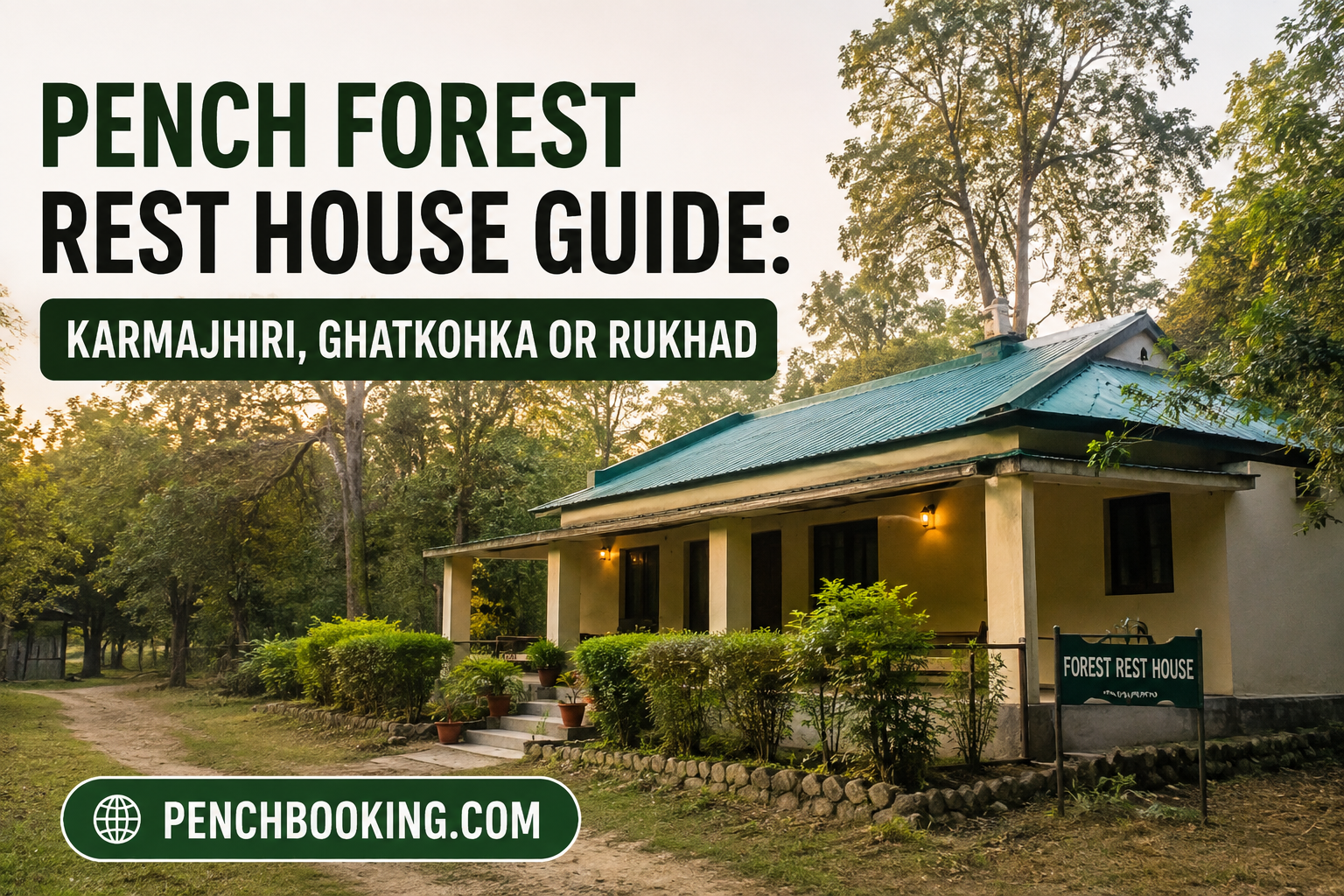
Pench Forest Rest House Guide: Karmajhiri, Ghatkoh...
If you are planning a stay inside Pench National Park and want to stay close to the forest without booking a private resort, the government forest re...
Read More
Best Places to Visit in Pench Beyond the Jungle Sa...
When most people think about Pench , the first thing that comes to mind is that gypsy safari kind of idea. And honestly it makes some sense, because...
Read More