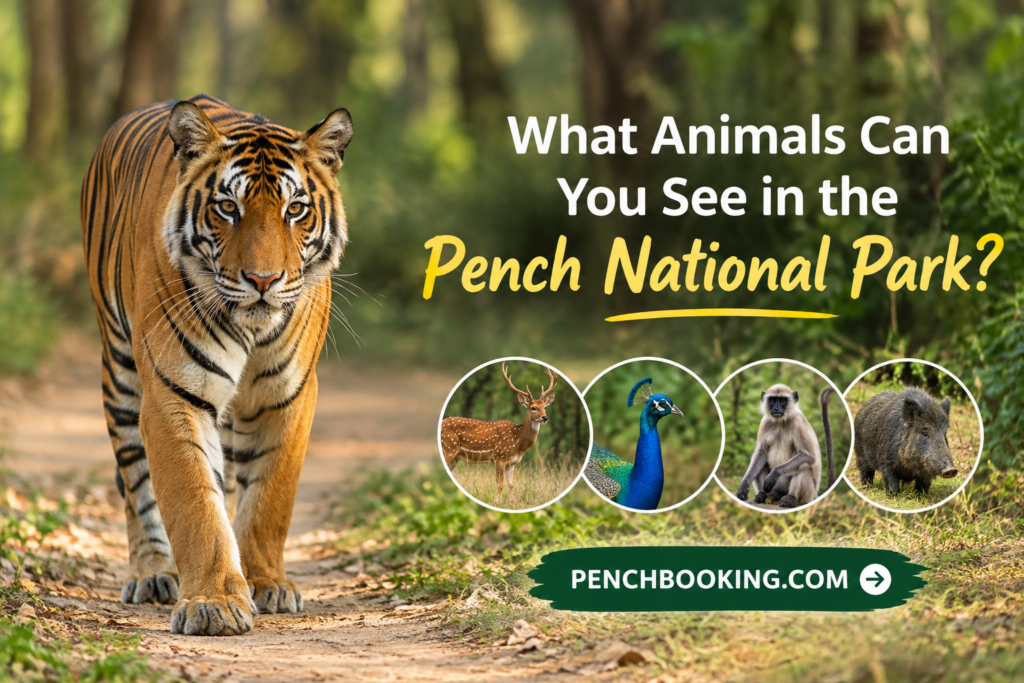
Pench National Park is one of those places that stays with you long after the safari ends. This is Mowgli’s real jungle. Same teak-covered hills, same winding river, same wild animals Rudyard Kipling wrote about back in 1894 — still here, still thriving.
The reserve stretches across Seoni and Chhindwara districts of Madhya Pradesh and dips into Nagpur district of Maharashtra. Inside it: 39 mammal species, 37 reptile species, 13 amphibian species, and over 300 bird species. Prey density here is among the highest of any tiger reserve in India which is the real reason wildlife sightings are so consistent, not luck.
First timer or returning visitor, this guide covers every animal worth knowing about in Pench — zone tips, timing, the works.
Top animals to spot in Pench National Park
These are the ones most people come for. Also the ones most commonly sighted on a Pench jungle safari.
Royal Bengal Tiger
The tiger is what sells every Pench jungle safari booking, and the park delivers. 100+ tigers live in the reserve right now. Activity peaks early morning and late afternoon. Come April and May when the forest dries out — waterholes like Baginnalla, Junewani, and Ghursalghat become regular stops for tigers, and that is when close-range sightings happen most consistently.
Indian Leopard
Leopards are in Pench but staying out of sight is basically their full-time job. Tree branches, rocky outcrops, dense cover that is where they spend most of their time. The best window is dusk near forest edges or early morning trail crossings. What makes Pench different from most parks on this front is a melanistic leopard — a black panther — documented in the Karmajhiri zone. The population here is decent but because of how secretive they are, every sighting lands differently.
Indian Wild Dog (Dhole)
Dholes are honestly some of the most entertaining animals to watch in the entire park. They hunt in coordinated packs, bring down prey well above their weight class, and when a chase is happening in front of your jeep, it is the kind of thing people bring up for years afterward. River banks and forest edges during early morning safaris are your best spots. Unlike tigers, dholes are not shy, just very, very fast.
Sloth Bear
Shaggy, strong, and a bit unpredictable in movement. Sloth bears run mainly on termites, ants, and honey. Mostly nocturnal but they do come out around dusk, near thick undergrowth and termite mounds. Evening safari in the right area with some patience a sloth bear sighting is not uncommon at all.
Indian Gaur (Bison)
Largest wild cattle species on earth and a regular sight in Pench’s meadows. Some males cross 900 kg. They move through open grasslands and forest clearings in herds, most active in the mornings when grazing happens. Calm animals generally, but the sheer size of a full-grown gaur close up is something else.
Sambar Deer
The sambar is the tiger’s primary prey in Pench, ecologically the most important animal in the park in terms of what keeps the predator population fed. India’s largest deer, almost always found near water. That loud bark it makes when alarmed is often the first real sign a predator is somewhere close. Experienced guides listen to it constantly.
Chital (Spotted Deer)
Chital herds are visible throughout the park all day. Beautiful animals — spotted coat, graceful movement, always in numbers. Most abundant prey species here, which means they tend to cluster in areas where predators are also active. Large healthy chital herds are a direct indicator of a healthy forest.
Carnivorous animals in Pench National Park
Beyond the big cats, the predator ecosystem here runs deep.
Indian Wolf
One of the most elusive carnivores in Pench National Park. Prefers open grassland over dense forest, moves in small packs, mostly active at dawn and dusk. Shy, silent, communicates through soft howls, hunts with a level of coordination that is quietly impressive to watch. A wolf sighting on an evening safari at Pench is rare enough that people remember exactly where they were when it happened.
Striped Hyena
Nocturnal scavenger, almost never seen on a daytime safari. Plays a real role in the ecosystem — cleaning up carcasses, controlling disease spread. Late evening safari near the forest boundary is your only realistic shot.
Jungle Cat
The medium-sized, tawny coat, looks like a large domestic cat until you see it in context. More active early morning, found near dense ground cover and water. Not a common sighting but it happens.
Jackal
Jackals show up frequently near forest edges and open grassland patches, often in pairs. Opportunistic — they will trail a tiger kill from a safe distance and wait. Early morning safaris, jackals are usually among the first animals out.
Indian Fox
Smaller than a jackal, mostly active after dusk, lives in burrows in open areas near the buffer zones. Not a common sight but evening drives near open ground do produce them.
Common Palm Civet and Small Indian Civet
Both are nocturnal and rarely seen on daytime safaris. Present throughout Pench but part of the forest’s small carnivore community that most visitors never actually encounter.
Herbivores in Pench National Park
The herbivore population here is one of the richest in India. That richness is precisely what supports such a dense predator base.
Nilgai (Blue Bull)
India’s largest antelope and one of the most commonly seen large animals in Pench’s open areas. Males carry that distinctive blue-grey coat. They graze in small groups through meadows and open scrub, most active through the morning.
Barking Deer (Muntjac)
Small, shy, sticks to dense forest edges. Makes a sharp dog-like bark when alarmed — easy to hear, hard to locate. Present throughout Pench but easy to miss because it stays close to cover and blends in almost perfectly.
Four-Horned Antelope (Chousingha)
The only four-horned antelope in the world. Found in Pench’s dry scrub and hilly terrain, rarely out in the open. The kind of sighting that a mid-morning quiet drive occasionally produces — and that very few visitors ever actually get.
Wild Boar
Boars are throughout the park anywhere with dense undergrowth and water nearby. Move in groups called sounders, frequently seen rooting around in the soil. Key prey for both tigers and leopards in Pench National Park.
Chinkara (Indian Gazelle)
Small, slender, found in the drier open sections of the park. Shy and quick, usually spotted in pairs. Not the most talked-about animal here but genuinely one of the prettier ones.
Langurs and Rhesus Macaques
Both species are throughout the forest. Langurs especially are a critical alarm system — when they start calling loudly from the treetops, something big is moving below. Any good naturalist or guide on a Pench safari watches langur behavior before almost anything else.
Indian Porcupine
Nocturnal, rarely seen during safaris, present across the park. Most commonly spotted crossing tracks very early morning before sunrise or after dark.
Common Giant Flying Squirrel
One of the more unexpected sightings Pench produces. Glides between trees using the membrane stretched between its limbs, active at dusk. A forest rest house stay or a late evening nature walk gives you the best chance of catching one mid-glide.
Rare animals in Pench National Park
These are the ones that even regular Pench National Park visitors do not see. Any one of these is a genuinely special wildlife moment.
Black Panther (Melanistic Leopard)
Not a separate species — a melanistic form of the Indian leopard, dark coat caused by excess melanin. More secretive than a regular leopard, which is already hard enough to spot. Very few safari goers ever see one. Those who do tend to remember it as the highlight of every wildlife trip they have ever taken.
Indian Pangolin
One of the most trafficked and endangered animals on earth. Covered in overlapping keratin scales, feeds on termites and ants, rolls into a tight ball when threatened. Completely nocturnal and deeply elusive. A pangolin sighting is something experienced naturalists genuinely celebrate — it is that rare.
Rusty-Spotted Cat
World’s smallest wild cat and one of the hardest animals to spot anywhere in India. Lives in Pench’s dense undergrowth, entirely nocturnal, its spotted coat makes it nearly invisible in leaf litter. Very few regular Pench safari visitors have actually seen one with their own eyes.
Indian Wolf
Already covered under carnivores but belongs here too. In Pench National Park, wolf sightings are rare enough to qualify as genuinely exciting incidental encounters. Open grassland areas on an evening safari are your only real shot.
Smooth-Coated Otter
Found along the Pench River and near the Totladoh Reservoir. Excellent swimmer, sometimes spotted fishing in groups near the banks. Does not show up on regular jeep safaris often — boat safari near the reservoir gives you the better odds.
Striped Hyena
Nocturnal, solitary, present in Pench but almost never seen in daylight. An evening sighting near the forest boundary counts as a genuinely lucky encounter.
Birds in Pench National Park
Over 300 recorded species. Pench is one of the best birdwatching destinations in central India — whether birding is your main goal or something you enjoy between tiger sightings.
Year-Round Resident Birds
- Indian Pitta — multi-colored, unmistakable once you know what you are looking for
- Malabar Pied Hornbill — large, distinctive, yellow curved bill hard to miss
- Crested Serpent Eagle — powerful bird of prey, often heard calling from the canopy before you see it
- Osprey and Grey-Headed Fishing Eagle — both near the Pench River
- Indian Roller — electric blue wings visible even from a moving jeep
- Peafowl — throughout the park, especially near forest clearings
- Greater Racket-Tailed Drongo — one of the best mimics in the bird world, full stop
- Yellow-Footed Green Pigeon — bright and striking, found in fruiting trees
- Brown Fish Owl and Indian Scops Owl — both near water bodies
- Jungle Owlet — commonly heard calling at dusk from dense forest patches
- White-Rumped Vulture and Long-Billed Vulture — both critically endangered, both present year-round
Migratory Birds (October to February)
- Bar-Headed Goose and Pintail Duck arriving at Totladoh Reservoir through winter
- Ruddy Shelduck and Brahminy Duck on the water in solid numbers
- Indian Pitta moving through during monsoon
- Black Stork and various waders passing through migration windows
- Bluethroat spotted in reedy areas near the river
Birds of Prey
- Crested Hawk Eagle
- White-Eyed Buzzard
- Short-Toed Snake Eagle
- Grey-Headed Fishing Eagle
- Peregrine Falcon
Birding as a primary goal — October to February is when you come. Totladoh Reservoir is the single best spot for waterbirds and winter migrants in the whole park.
Reptiles in Pench National Park
37 recorded species. Overlooked by most visitors but a real part of what makes this ecosystem work.
- Mugger Crocodile
- Indian Rock Python
- King Cobra
- Spectacled Cobra
- Indian Krait
- Indian Monitor Lizard
- Indian Flapshell Turtle
- Peninsular Black Turtle
- Russell’s Viper
- Banded Kukri Snake
Frequently Asked Questions
39 mammal species, 37 reptile species, 13 amphibian species, and over 300 bird species.
100+ Royal Bengal Tigers currently recorded across the reserve.
Yes. A melanistic leopard has been documented in the Karmajhiri zone. Sightings are very rare but confirmed.
Indian pangolin and the rusty-spotted cat. Both nocturnal, both deeply elusive, almost never spotted on any safari.
Yes. Present in open grassland areas, rarely spotted, and considered one of the most exciting incidental sightings on an evening safari.
Over 300 species — Indian Pitta, Malabar Pied Hornbill, Osprey, Crested Serpent Eagle, Peafowl, Indian Roller, White-Rumped Vulture, and large numbers of migratory birds at Totladoh Reservoir in winter.
Yes. Mugger crocodiles are regularly spotted along the Pench River and near Totladoh Reservoir.
Yes. Commonly seen during early morning safaris near river banks and forest edges. A pack hunt in full motion is one of the top safari experiences the park offers.