
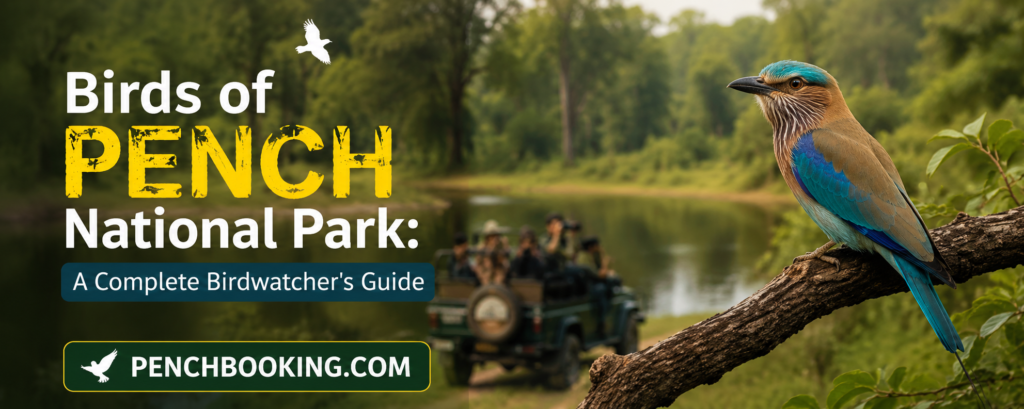
Most people visit Pench National Park hoping to spot a tiger. That is completely fair. But what surprises many visitors is how much the forest has to offer beyond big cats. The moment you step into Pench, you hear it before you see it — a rich layering of calls, whistles, and wing beats drifting through the teak trees. Pench is genuinely one of the best birdwatching destinations in Central India, and it deserves far more attention from birding enthusiasts than it currently gets.
Whether you are planning your first birdwatching safari in Pench National Park or you are a seasoned birder looking to tick off new species, this guide covers everything you need to know.
How Many Bird Species Are There in Pench National Park?
Pench National Park is home to over 285 resident and migratory bird species, and some more recent counts even seem to land around 300 species in the whole reserve. You can spot raptors, waterfowl, forest birds, and there are also plenty of seasonal visitors. The park has a mix of dense teak and sal forests, along with open grasslands, the Pench River, and several wetland areas, which sort of forms different micro habitats. Each of those places draws in its own set of birds, like a quiet little parade. That variety is really what makes birdwatching in Pench so rewarding.
Birds You Are Most Likely to See in Pench
Some species you can expect to spot with reasonable confidence during a visit to Pench:
The Indian Peacock is everywhere. It struts through grasslands and forest edges, especially around dawn. You will almost certainly see one on every safari.
The Indian Roller is a favourite among visitors and photographers alike. Its flight reveals a brilliant splash of blue and turquoise that is genuinely hard to believe is natural.
The Malabar Pied Hornbill is one of the more exciting sightings. This large, noisy bird with its dramatic casque-topped bill is found near fruiting trees in denser forest areas.
The Crested Serpent Eagle is regularly seen perched on high branches, scanning the forest floor. It has a distinctive round crest and a sharp, piercing call that carries through the trees.
The Indian Pitta is a forest gem. Small, brilliantly coloured, and somewhat shy, it moves through the undergrowth and rewards patient observers. Birders who specifically come looking for this species rarely leave disappointed.
The Asian Paradise Flycatcher is another highlight. The male has long white tail streamers that trail behind it as it moves through shaded forest. It looks almost unreal.
Along the Pench River, you can spot the Stork-billed Kingfisher, the largest kingfisher found in this region, as well as Painted Storks, River Terns, and River Lapwings. The Osprey is also regularly sighted here, diving dramatically into the water for fish.
Migratory Birds in Pench Tiger Reserve
One of the best reasons to visit Pench between November and February is the arrival of migratory birds. Winter brings thousands of waterfowl to the Pench reservoir, Totladoh, and smaller water bodies across the park.
Some common winter visitors are the Brahmini Duck, the Bar-headed Goose, the Northern Pintail, the Ruddy Shelduck, Lesser Whistling Teal, and Red-crested Pochard. These flocks sort of give park birdlife a whole different kind of dimension , turning calm water surfaces into lively, colourful meet-ups.
Also raptors move through in the cooler seasons, including the Osprey and a whole range of sandpipers. If you stay patient, and you’re placed near a water body at the right time of morning , the sightings can be genuinely extraordinary.
Best Time for Birdwatching in Pench National Park
The best time for birdwatching in Pench is between November and April, but the experience shifts depending on the month.
November to February is ideal for migratory birds. The weather is comfortable, the skies are clear, and bird activity near water bodies is high. This is also peak safari season, so book early.
March to May shifts the focus to resident species. The forest becomes drier and less leafy, which actually makes it easier to spot birds. Raptors are especially active, and many species are calling more frequently as breeding season approaches.
April and May are particularly good for hearing and spotting the Indian Pitta, as the species becomes vocal during this period.
The park is closed during monsoon (roughly July to mid-October), so birdwatching is not possible during those months.
Best Spots for Bird Watching in Pench
The Pench River area is probably the single best location for bird watching. The riverbanks attract waterfowl, kingfishers, herons, storks, and raptors. This is also where you have the best chance of seeing the Osprey and Brown Fish Owl.
Sitaghat and Raiyakassa are scenic river spots that are specifically noted for bird watching. If your jeep safari takes you through this stretch, slow down and look carefully.
Runijhuni Trail is a walking trail inside the park that gives you the opportunity to bird on foot. More or less at about three kilometres , you kind of pass through a mix of habitats and it’s especially good for forest species that are tricky to see from a moving vehicle.
Bodanala along with other quiet water bodies in the park turn into real hotspots during winter, when migratory ducks and waders show up in quite large numbers.
The buffer zone and the spaces around lodges and resorts near Pench also give surprisingly solid birding, in particular early in the morning , right before your safari.
Tips for Birdwatching in Pench
Go out early. The first two hours of daylight are the most active period for birds, and early morning safaris give you the best light for both spotting and photography.
Carry binoculars. This is non-negotiable. A pair of 8×42 or 10×42 binoculars will make a significant difference to how much you see.
Move slowly and quietly. Whether you are on a walking trail or a jeep safari, unnecessary noise reduces your chances of spotting shy species.
Ask your guide to help with calls. An experienced naturalist at Pench can identify birds by sound alone, which dramatically increases the number of species you encounter.
Keep a checklist. Noting down what you spot makes the experience more engaged and gives you a record to refer back to.
Book through a reliable service like pench safari booking to ensure your safari slots are secured in advance, especially during peak birdwatching season from November to January when availability is limited.
FAQs
Over 285 resident and migratory species have been recorded, with some counts reaching 300+.
November to April. November to February is best for migratory birds; March to April is great for resident species.
Yes. Winter brings waterfowl like Brahmini Duck, Bar-headed Goose, Northern Pintail, and Osprey to the park’s water bodies.
Indian Pitta, Brown Fish Owl, River Lapwing, and Asian Paradise Flycatcher are among the more sought-after species.
Yes. The Runijhuni walking trail inside the park is available for birdwatching on foot with a guide.
Pench River banks, Sitaghat, Bodanala, and the Runijhuni Trail are the top locations.
Birdwatching within the park is covered under the standard safari permit. Walking trails may have separate permissions — check with your guide or operator.
Yes. The open terrain, river areas, and high bird diversity make it an excellent destination for wildlife and bird photography.
Conclusion
Pench National Park isn’t only a tiger reserve, it’s more like a living ecosystem, breathing and shifting all the time. Over 285 bird species get shelter and food, and also those essential migration routes through places that range from dense forest, to open water. So like, whether you’re watching an Osprey do a sudden dive for fish on the Pench River or hearing an Indian Pitta calling from deep in the undergrowth, or even noticing a flock of Bar-headed Geese settling on a winter reservoir, the birding experience feels genuinely special here.