
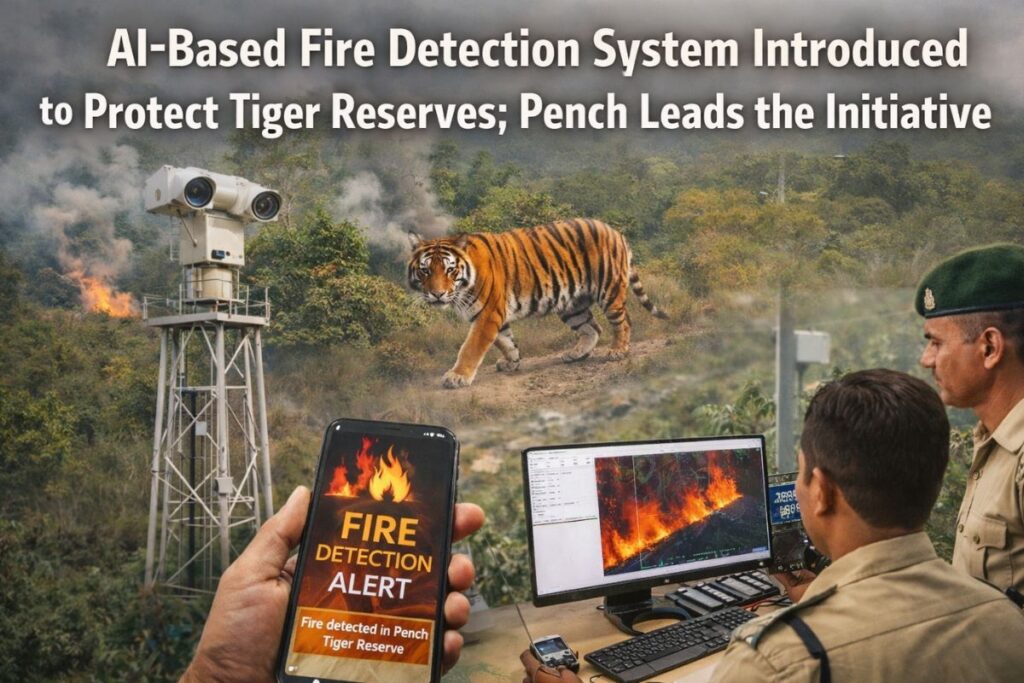
Pench Tiger Reserve has become the first tiger reserve in the region to introduce a new Artificial Intelligence (AI) based forest fire detection system to improve forest protection. This advanced technology will help forest officials detect fires quickly and respond faster, reducing the risk of large-scale damage to forests and wildlife.
The new system uses high-resolution thermal cameras and pan-tilt-zoom (PTZ) cameras that are installed on high towers or hilltops inside the forest. These cameras are equipped with infrared sensors that can monitor large forest areas and detect possible fire signals from up to 15 kilometres away.
Images captured by the cameras are sent to a central computer system where AI software analyses them in real time. The system can identify smoke, flames, or unusual heat patterns and can also differentiate them from natural elements such as clouds, fog, or dust. This helps reduce false alarms and ensures alerts are sent only when there is a real fire risk.
When the system detects a fire, it automatically sends alerts to forest officials through mobile messages and email notifications. This allows forest staff to quickly reach the location and control the fire before it spreads.
The platform can also connect with GPS-enabled vehicles, firefighting teams, and nearby water sources, helping authorities coordinate firefighting efforts more efficiently.
Installing one AI fire detection unit costs about ₹80 lakh with thermal cameras or around ₹55 lakh with PTZ cameras. The yearly maintenance cost from the second year is estimated at about ₹4.5 lakh.
According to M S Reddy, director of the Chandrapur Forest Academy of Administration and Management, this initiative comes at an important time as the Indian Forest Act of 1927 will complete 100 years in 2027. He explained that forests are not just groups of trees; they help control climate, store carbon, protect wildlife, and support the livelihoods of millions of people. Forest fires can destroy years of natural growth within a few hours.
He also emphasized that technologies like AI fire detection systems are designed to assist forest staff in their work, not replace them, making forest protection faster and more effective.