
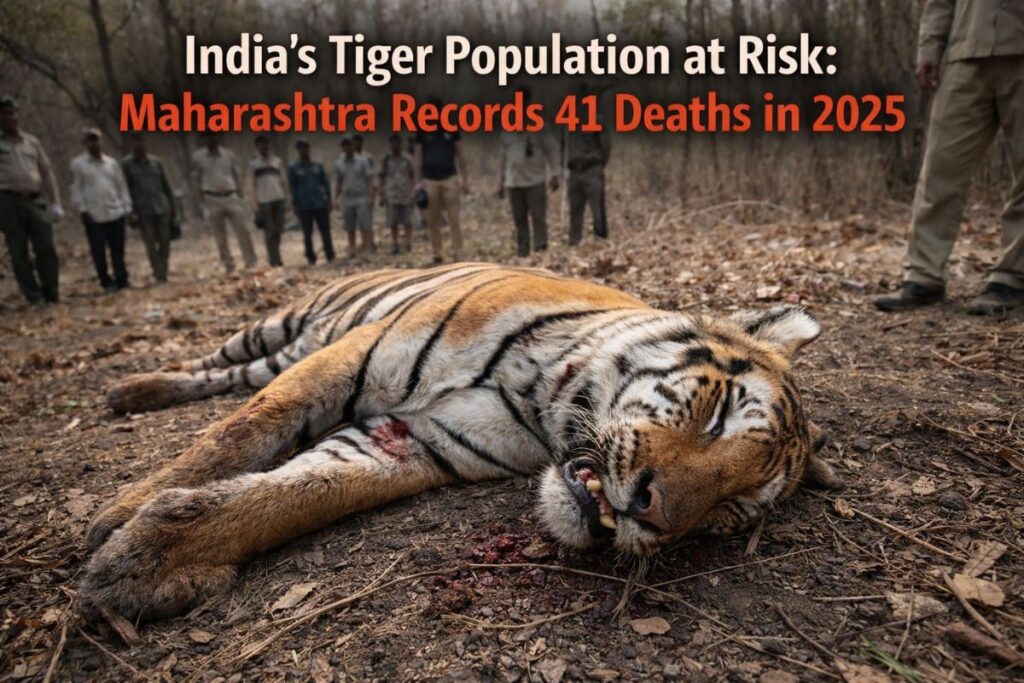
In 2025, the state of Maharashtra recorded 41 tiger deaths, as shared during the ongoing Budget session in the Legislative Council. During the same time, a total of 166 tiger deaths were reported across the country.
Forest Minister Ganesh Naik shared this data while answering questions raised by members about tiger deaths in Pench Tiger Reserve. He also mentioned that these figures are based on official records maintained by the National Tiger Conservation Authority.
Concerns Over Recent Tiger Deaths in Pench Tiger Reserve
During the Legislative Council session, members like Satyajit Tambe and Parinay Fuke asked the government for more details after reports of the deaths of one adult tiger and two cubs in Pench Tiger Reserve.
As per the information given in the House, the body of an adult tiger was found on December 2, 2025, in compartment number 329 of the Saleghaat forest area. In another case, a tiger cub was found dead on January 7 in the Deolapar zone of Khursapar.
In his written reply, Forest Minister Ganesh Naik said that early investigation suggests the cub found in January may have died due to a fight between tigers. He also mentioned that another cub, whose body was found earlier in a decomposed condition, likely died due to natural causes.
Steps Taken to Stop Poaching
The Forest Minister said that the government has taken several important steps to prevent poaching and improve wildlife protection in the state.
Special teams of the Special Tiger Protection Force (STPF) regularly patrol highly sensitive forest areas to keep a close watch. Dog squads are also used to track and detect hunting-related activities. Forest staff have been given mobile devices connected to the M-Stripes system, which helps them monitor animal movement and identify any suspicious activity inside the forests.
In addition, informers have been appointed at different forest ranges to collect secret information about illegal poaching. The minister also mentioned that special funds are used to support and reward this intelligence work.
Strong Monitoring and Surveillance in Forests
The authorities have improved monitoring systems in sensitive wildlife areas to better protect animals.
Camera traps have been placed in important locations like tiger corridors, near water bodies, and other key spots to detect any suspicious activity. Forest officials also regularly check water sources to make sure no one is trying to poison animals.
Metal detectors are being used to find iron traps that poachers may hide along animal paths, especially near water areas. In addition, checkposts have been set up in highly sensitive forest zones to check vehicles entering and leaving these areas.
Wildlife Crime Control and Cyber Monitoring
A special Wildlife Crime Cell has been set up at the office of the Principal Chief Conservator of Forests in Nagpur to monitor and control wildlife-related crimes. The government is also working to make this system stronger.
A cyber cell at Melghat Tiger Reserve is also helping officials track people who may be involved in poaching and take quick action against them.
To improve monitoring in forest areas, protection huts and watchtowers have also been built.
Rising Human-Wildlife Conflict
The issue of increasing conflict between humans and wildlife, along with poaching, has been widely discussed during the Budget session of the State legislature.
Many leaders have raised concerns about the deaths of both people and animals, including tigers and leopards. Forest Minister Ganesh Naik explained that changes in animal behaviour and their natural habitats are leading to more encounters between animals and humans. In many cases, wild animals are now entering nearby villages and farm areas.
To manage this situation, forest teams have started tracking tigers and leopards every two weeks at the range level. Officials also inspect nomadic settlements near villages to monitor movement in sensitive areas.
Plan to Change Leopard Protection Status
The Forest Minister also said that the State Cabinet has approved a proposal to change the protection level of leopards.
At present, leopards are listed under Schedule I of the Wildlife Protection Act (WLPA), which gives them the highest protection. The Maharashtra government has requested the Ministry of Environment, Forest and Climate Change to move leopards to Schedule II, where the protection level is lower and penalties are less strict.