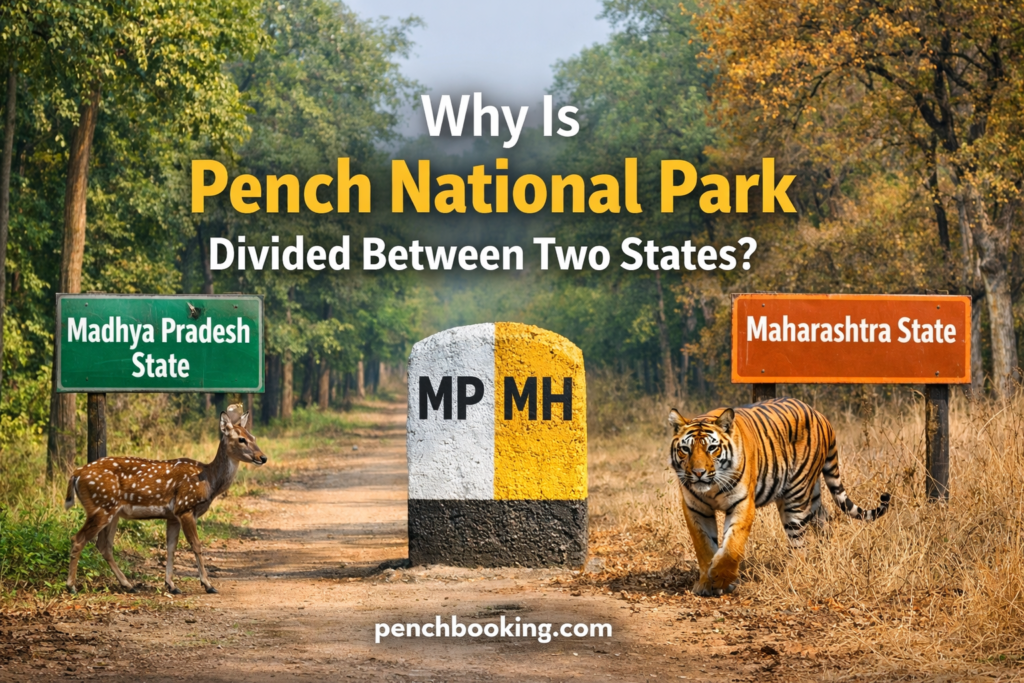
Many first-time visitors are surprised to learn that Pench National Park is located in both Madhya Pradesh and Maharashtra. This often leads to questions like, “Is it one park or two?” or “Which state has the better safari?”
The truth is simple: Pench is one continuous forest ecosystem that naturally extends across the state border. The administrative boundary between Madhya Pradesh and Maharashtra cuts through the forest, but the wildlife does not recognize these political borders.
In this guide, we’ll explain why Pench National Park divided between two states, how it is managed, and what visitors should know before planning their safari.
The History Behind Pench National Park
Pench National Park gets its name from the Pench River, which flows through the heart of the forest. Long before modern state boundaries existed, this region was a vast stretch of forests filled with tigers, leopards, deer, wild dogs, sloth bears, and hundreds of bird species.
When India’s states were reorganized after independence, the forest happened to fall within the borders of Madhya Pradesh and Maharashtra. Instead of separating the forest physically, both states agreed to protect their respective portions while maintaining the ecological integrity of the landscape.
Today, Pench remains one of India’s finest examples of a shared wildlife landscape.
One Forest, Two States
Although tourists often refer to them separately, the forests are connected.
· Pench Tiger Reserve (Madhya Pradesh) covers the larger portion of the protected forest.
· Pench Tiger Reserve (Maharashtra) protects the southern section of the same ecosystem.
Together, these forests form an important habitat for Bengal tigers and many other wild animals.
The animals freely move across the state border in search of food, water, mates, and territory. Tigers do not stop at state checkpoints—they roam wherever suitable habitat exists.
Why Was Pench Not Kept in One State?
The answer lies in geography rather than wildlife management.
The forest naturally spreads across central India, while the political boundary between Madhya Pradesh and Maharashtra passes through it.
Changing state borders simply to keep a forest within one state would have been impractical. Instead, both governments chose to protect their respective areas while coordinating conservation efforts.
This approach has helped preserve one of India’s most important tiger habitats.
How Is the Park Managed?
Even though Pench is one ecosystem, each state has its own Forest Department.
Both administrations are responsible for:
- Wildlife conservation
- Anti-poaching patrols
- Habitat management
- Safari operations
- Tourism regulations
- Forest staff and guides
They also cooperate on conservation programs because wildlife frequently moves between both states.
This collaborative management plays an important role in protecting tiger populations across the landscape.
Is the Tigers Shared?
Tigers do not recognize state boundaries. They move freely between the forests of Madhya Pradesh and Maharashtra in search of food, water, mates, and new territories.
Safari Experience in Both States
Both sides of Pench offer memorable wildlife experiences, but there are some differences.
Madhya Pradesh Side
Larger tourism zone
More Pench safari zones
Higher number of safari vehicles
Better-developed tourism facilities
Popular choice for first-time visitors
Maharashtra Side
Usually quieter and less crowded
Fewer safari vehicles
Peaceful forest experience
Good chances of wildlife sightings
Ideal for visitors who prefer a calm safari
Neither side guarantees tiger sightings, as wildlife encounters always depend on nature.
Which State Is Better for Tiger Sightings?
The reality is that both states offer excellent tiger habitats.
Tiger sightings depend on many factors, including:
- Season
- Weather
- Animal movement
- Water availability
- Safari timing
- Natural luck
Experienced guides and drivers on both sides work hard to provide visitors with the best possible wildlife experience.
Why Is Pench So Important for Tiger Conservation?
Pench is much more than a tourist destination.
The reserve serves as an important wildlife corridor connecting forests across central India.
These connected landscapes allow animals to:
- Maintain healthy breeding populations
- Expand territories naturally
- Reduce genetic isolation
- Adapt to changing environmental conditions
Protecting forests across both states strengthens India’s long-term tiger conservation efforts.
The Famous Mowgli Connection
Many visitors associate Pench with Mowgli, the fictional character created by Rudyard Kipling in The Jungle Book.
Although the story is fictional, the forests of Pench are widely believed to have inspired the landscapes described in the famous book.
This connection has made Pench one of India’s most recognized wildlife destinations.
Travel Tips Before Visiting Pench
To enjoy your safari:
- Book your Pench safari booking well in advance.
- Visit during the dry season for better wildlife visibility.
- Carry binoculars and a camera.
- Wear comfortable, earth-coloured clothing.
- Follow all forest department guidelines.
- Maintain silence during the safari.
- Respect wildlife and never attempt to attract animals.
Frequently Asked Questions
It is located in both states. The forest extends naturally across the state boundary.
Yes. Tigers, leopards, deer, wild dogs, and many other animals regularly move across the connected forest.
The Madhya Pradesh section covers a larger protected area, while Maharashtra protects the southern portion of the same ecosystem.
Yes. Safari permits are issued separately by each state’s Forest Department, and visitors must book according to the zone they wish to visit.
Final Thoughts
Pench National Park is divided between Madhya Pradesh and Maharashtra not because it is two different forests, but because one magnificent natural landscape happens to lie across a state boundary.
For wildlife, there are no political borders. Tigers, leopards, elephants, birds, and countless other species move freely through this connected ecosystem, making Pench one of India’s most valuable tiger landscapes.
Whether you choose to explore the Madhya Pradesh side or the Maharashtra side, you’ll experience the same rich biodiversity, beautiful teak forests, and the excitement of seeing wildlife in its natural home.